Tufts University’s Department of Public Safety
April 1, 2026SUFFOLK COUNTY SHERIFF’S DEPARTMENT ISSUES WARNING OF MULTIPLE SCAMS, INCLUDING OFFICER IMPERSONATION
SUFFOLK COUNTY SHERIFF’S DEPARTMENT ISSUES WARNING OF
MULTIPLE SCAMS, INCLUDING OFFICER IMPERSONATION
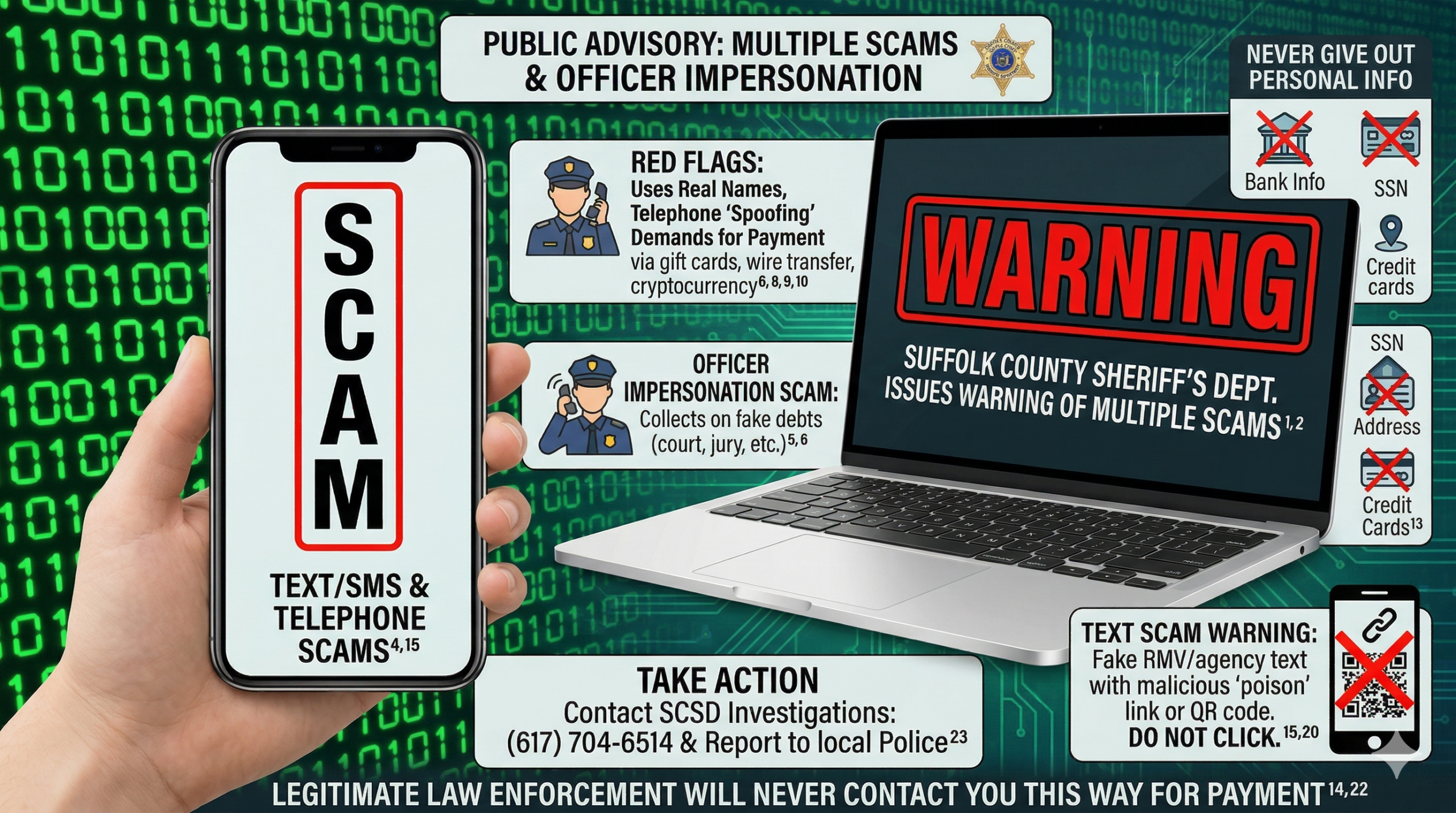
The Suffolk County Sheriff’s Department (SCSD) is warning residents of Suffolk County and beyond about a series of scams including those involving the impersonation of Department officers and other law enforcement agencies.
According to numerous reports and complaints filed at law enforcement agencies around the state, including the SCSD, scammers have been targeting their potential victims through a variety of different electronic mediums, including telephone calls, emails, and even postal mail using a combination of both simple and more sophisticated technology.
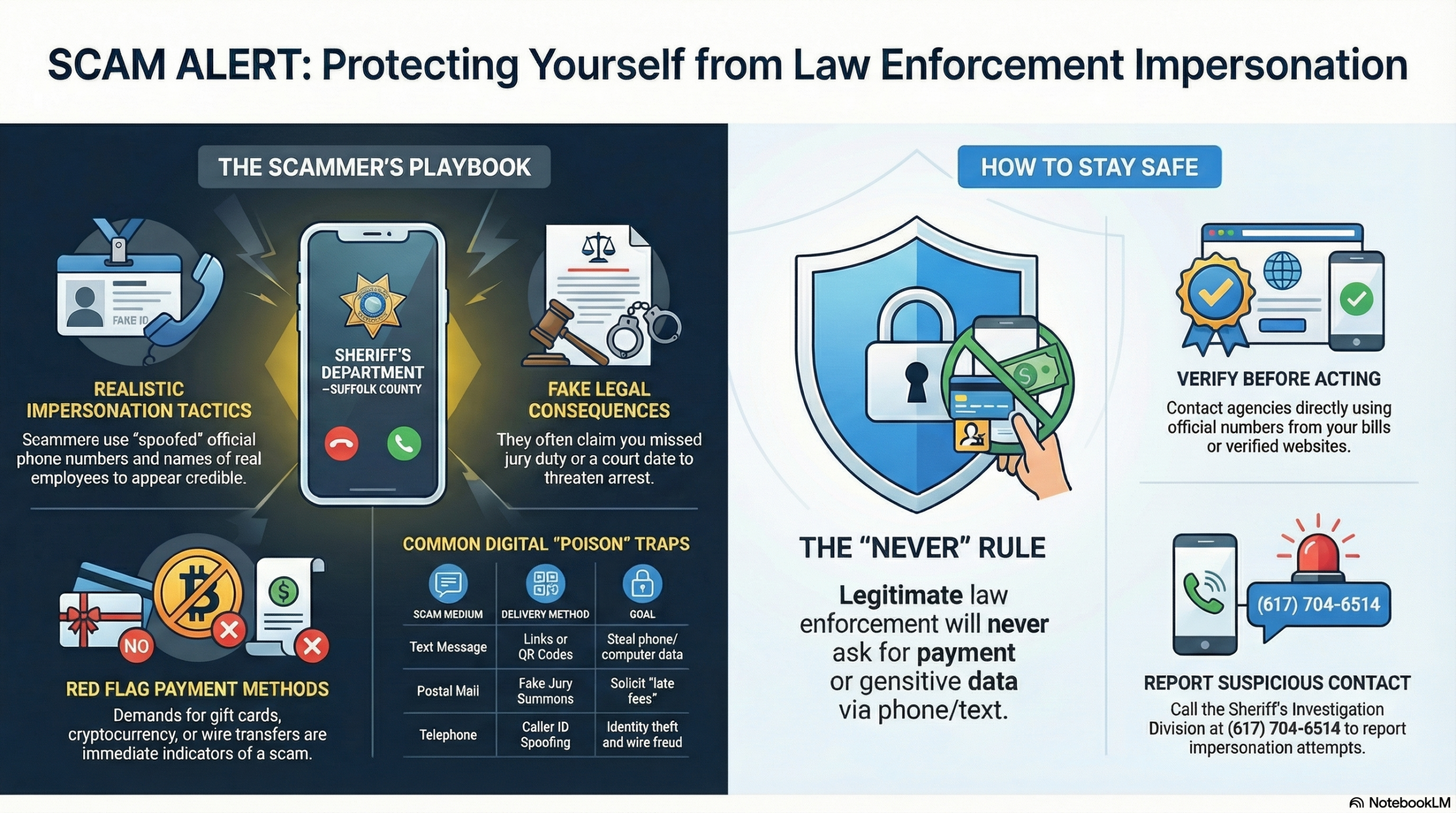
In one scam operating across Suffolk County and in surrounding communities, callers identify themselves to potential victims as either an officer or staff member from the Sheriff’s Department claiming to be attempting to collect on a debt that the listener allegedly owes for either missing a court date, missing jury duty or some other false circumstance. With these calls, the scammer uses a combination of techniques that lend them an air of credibility, which include using the names of real Suffolk County employees, and telephone line “spoofing,” which makes it appear to the potential victim as if the caller is actually dialing from the organization that they claim to be representing. In cases where the potential victim does basic research, these techniques can make it appear that the calls are legitimate, which could, in turn, lead the potential victim fall for the scam.
In almost all of these instances, the caller will ask – and, in some cases, demand under the threat of potential arrest – money from their intended victim to make up for court costs, late or –“no-show” fees, etc. to be paid in a variety of ways, including using “cash money” or gift cards; single use, pre-paid credit cards; telegraph or wire services like Western Union, cashier’s checks, Bitcoin and similar cryptocurrency, in addition to several other methods. With respect to the use of gift cards or pre-paid credit cards, the scammer will ask for the pin numbers on these cards to gain access to payment, and the scammer then steals the victim’s money. On less-frequent occasions, potential victims are asked to meet the caller at a location of the caller’s choosing, sometimes in a location close to the agency that they are claiming to represent, in an effort to, once again, add an air of credibility to the scam.
Residents receiving these calls are cautioned to NEVER: send money or give any personal information, including credit card numbers; bank routing numbers; Social Security Numbers; birthdates; full names; or addresses.
Remember – the Suffolk County Sheriff’s Department will never contact you in the ways that are mentioned above, nor will any other legitimate law enforcement agency.
Additionally, there are also text scams that target cellphone users, with predators pretending to be from the Registry of Motor Vehicles or another local agency using texts to claim that potential victims have unpaid tolls or traffic tickets and are being issued a “final warning” for payment. There is usually a link or a QR code that the scammers include, which should never be clicked or used by the people receiving them, because they are designed to steal the information of the scammer’s intended victim through access to their phones or computers.
While the telephone and text scams are among the most popular, due to their ability to collect instant payment from their victims, there are several others making the rounds that residents should also be on guard against.
On rare occasion, in an attempt to boost the authenticity of the call, the scammer also creates and sends a fake “Summons for Jury Duty” form with the intended victim’s name and current address printed on it, marked with a date that has already passed, indicating the date that the scammer claims their intended target failed to report for jury duty. In this instance, and like all of the other listed scams, there will never be an attempt to collect money from missed juror service, but if you’re concerned and would like to check the status of your jury duty just to verify that you’ve been the target of a scammer, Contact the Office of Jury Commissioner (OJC) Juror helpline (toll-free in Massachusetts) at (800) 843-5879 (THE-JURY) or visit the Office of the Jury Commissioner’s Delinquent Juror page at: www.mass.gov/info-details/delinquent-jurors-and-the-delinquency-process.
There are also various scams involving streaming movie services, cable, banking institutions, etc. that are all designed to steal either your money, your information, or both via “poison” links, false phone numbers, or fraudulent emails. When in doubt, contact your carrier directly at an official telephone number provided on your bill, on your credit or bank card statement, or on the respective organization’s official website.
Once again, legitimate law enforcement agencies will not contact you for payment for any of the above reasons, and if you are ever in doubt about the legitimacy of any organization calling, emailing or texting you, stop communication with them immediately and contact your local law enforcement agency to report the scam. Residents receiving scam calls from people posing as Suffolk County Sheriff’s Department officers and employees are also encouraged to call our Sheriff’s Investigation Division at (617) 704-6514, and to also file a complaint with their local law enforcement agency.